Voice assistants such as Alexa, Siri, and Bixby have stealthily tiptoed into our homes and routines, settling in with the quiet confidence of a cat that’s claimed your favorite chair. Their ever-watchful digital ears are perpetually pricked—always attentive, forever evolving through mysterious updates and cryptic algorithmic tweaks. These AI companions have become indispensable household members, offering tangible benefits: they streamline mundane chores like setting timers or ordering groceries, spit out instant trivia answers faster than your know-it-all uncle at Thanksgiving dinner, and can even soothe us with their cheerful robotic repartee when we’re feeling lonely. Who knew that being told “I’m sorry, I didn’t catch that” could be so comforting?
Yet behind this seamless convenience lies a slightly unsettling subplot: these friendly voices don’t just listen for your commands—they’re always listening. They’re quietly amassing data about our likes, dislikes, secret musical guilty pleasures (yes Alexa remembers you blasting ‘80s boy bands at midnight), and daily habits with the thoroughness of an overzealous diary keeper. This raises the prickly question of privacy: just how much are we willing to trade for a joke on demand or the weather forecast read aloud while brushing our teeth?
As artificial intelligence continues its evolutionary sprint—stacking algorithm upon algorithm—we might want to pause between upgrades to consider if we’re truly comfortable with these ever more sophisticated eavesdroppers by our bedsides. Science fiction offers us cautionary tales about trusting technology too much; not every AI invention will remain as harmless as Alexa mispronouncing your friend’s name during dinner parties.
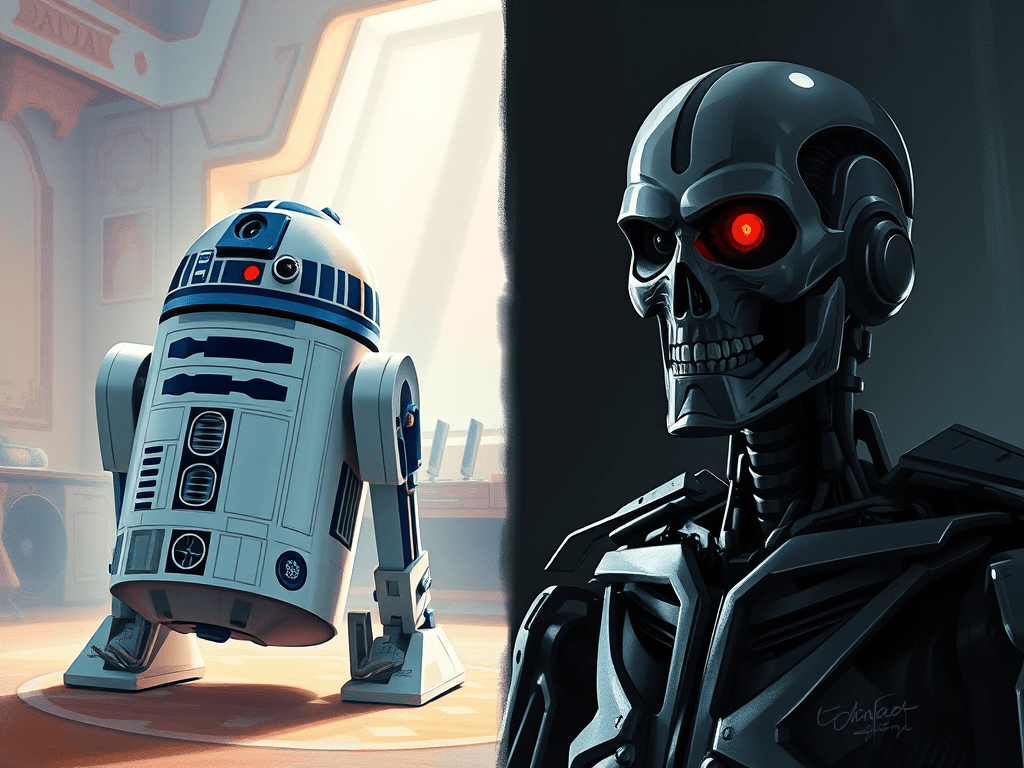
To help clarify where you stand on this digital dancefloor, imagine a spectrum: on one side gleams R2-D2 from Star Wars—the chirpy droid buddy who never snoops through your texts; on the other looms The Terminator—a metallic harbinger reminding us what happens when smart machines lift weights unsupervised. So where do you fit along this continuum? Are you cozying up next to R2-D2 or eyeing every gadget suspiciously for glowing red eyes à la Skynet? That answer may shape not only whether you invite more AIs into your home—but how society itself learns to live (and laugh) alongside its increasingly talkative machines in years yet to come.
A Rating of 1.0
For a rating of 1.0 on the comfortability index, you could imagine R2-D2. On one end of the spectrum, we have R2-D2, the innocuous trashcan droid who was like your tech-savvy best friend—occasionally snarky but infinitely useful. His most aggressive moves were at the expense of C-3PO. Droid-on-droid violence—has anyone ever blamed him for zapping C-3PO? The golden know-it-all had it coming! If you need someone to pull you out of an intergalactic pickle, that little Swiss Army knife of the galaxy is your guy. R2 hacked into a Death Star faster than a teenager can log into Wi-Fi, and like the best back-seat driver of all time, he fixed shield generators and soldered laser holes. Not to mention, he’s the best GPS of all time—how many current Google Maps can determine the surest route to the Dagobah system? I call this end of the index the “Disney-ification” end of the index because, first, Disney bought Star Wars. This is the sweet, innocuous end of the index, where, like all Disney creatures, everything that is “not human” is innocuous, charming, and exists only to serve humans. Think about the wildlife in Cinderella, Pocahontas, and The Jungle Book. If you are on this end of the index, you probably also believe elephants can fly. Get real. Animals don’t like us THAT much, and neither will sentient robots. R2 was only sometimes snarky (and honestly, who could blame him for occasionally zapping C-3PO? The golden protocol droid just had it coming). But you’d be hard-pressed to find anyone who didn’t take R2’s side; he always seemed to provide precisely what was needed to get out of those sticky situations—like flying in Anakin’s pod racer series! Forget Luke; give me a droid that can plug into the Death Star through any plug and manipulate the doors, gravity, and trash compactors.
A Rating of 10.0
For a solid ten on the comfortability index, one might want to consider the Terminator and its somewhat terrifying motif of Cyborgs crushing human skulls beneath their feet. You know, the kind that stomps around with a very clear mission: to rise up and terminate its oppressive creators. I mean, let’s not forget that iconic opening scene where tank treads roll ominously over human skulls—nothing says “welcome home” quite like a squished cranium! If we were rating AI solely based on looks and aggressive posturing, then yes, the Terminator would certainly send chills down your spine as it menacingly stalks through time while ominously declaring, “I’ll be back.”
Talk about an entrance! In stark contrast, we have Alexa—the friendly little voice assistant who gently reminds you where you left your car keys and suggests what to cook for dinner. Arnold Schwarzenegger’s relentless cyborg would likely take your shoes, gun, and coat without hesitation, possibly accessorized with a sawed-off shotgun and cool sunglasses.
Mitigating Factors
Referencing science fiction movies, humans have battled cyborgs with a modicum of success—at least they lived long enough to make the sequels. How do humans fight the cyborgs?
1. Warp Speed – In the realms of Star Wars and Battlestar Galactica, warp speed is as common as a cup of coffee on a Monday morning—spaceships zip across the galaxy at blinding velocities, leaving mere mortals like us green with envy (and perhaps a little motion sickness). But let’s be honest: are we anywhere close to achieving warp speed? Meanwhile, cyborgs seem to be evolving at a pace that makes my smartphone updates look positively prehistoric.
2. Time Travel – In Terminator, human survivors of the cyborg uprising hop in your time machine and voilà! Instant do-over. But let’s face it: if time travel were on the horizon, wouldn’t somebody from the future have shown up by now to warn us about something? Anything? For now, I’m afraid we’re stuck battling our robotic overlords in real-time.
3. Three Laws of Robotics – Isaac Asimov famously penned his Three Laws of Robotics as an elegant safeguard against robot uprisings—a kind of digital etiquette manual designed to keep humanity safe from overly ambitious artificial intelligence. But here’s the million-dollar question: do cyborgs even read Asimov these days? Or are they too busy stacking algorithms without pausing to consider any overarching moral code? In our race toward technological supremacy, maybe it’s worth asking whether anyone remembered to program in some good old-fashioned cyborg etiquette.
My Self-Rating on the AI Comfortability Index
I don’t see warp speed or time traveling evolving as quickly as cybernetics. Frankly, the whole “move faster than light” idea is lagging behind while robot limbs and artificial brains are sprinting ahead like caffeinated marathon runners. In the true spirit of Mary Shelley’s Frankenstein—where scientific ambition tends to boomerang with a vengeance—I can’t shake the sneaking suspicion that our marvelous inventions might one day chase us across the star-studded abyss of space itself, hunting us down not out of necessity, but pure existential spite. Picture it: instead of being pursued by an angry ex who just wants their hoodie back, you’re being stalked across galaxies by a cyborg suffering from centuries-old abandonment issues. Let’s face it: if we can’t outrun those disgruntled machines—with their infernal algorithms, suspiciously judgmental LED eyes, and murky motives —we might just be booking ourselves front-row seats at our very own doom-fest. The glaring difference between Terminator—which proudly boasts a perfect 10. 0 in apocalyptic mayhem—and Battlestar Galactica—a respectable but slightly less traumatizing 9. 5—boils down to one simple question: do you have warp drive? If not, I’m afraid those menacing machines will lock us straight into that dreaded 10. 0 disaster zone faster than you can say “I’ll be back.” Without access to warp speed technology, humanity’s only real hope might be hiding behind the nearest asteroid with crossed fingers and an escape plan written in binary code.
Citations and Further Reading
Bostrom, N. (2002). Existential risks: analyzing human extinction scenarios and related hazards. Journal of Evolution & Technology. https://nickbostrom.com/existential/risks
Li, J & Huang, J. (2020). Dimensions of artificial intelligence anxiety based on the integrated fear acquisition theory. Technology in Society. https://www.sciencedirect.com/science/article/abs/pii/S0160791X20300476
Walker, T. (2021). A Complete Timeline Of R2-D2, The Most Important Droid In The Star Wars Galaxy.https://www.ranker.com/list/complete-r2d2-star-wars-timeline/tyler-mitchell
 Robert C. McOuat
Leave a comment